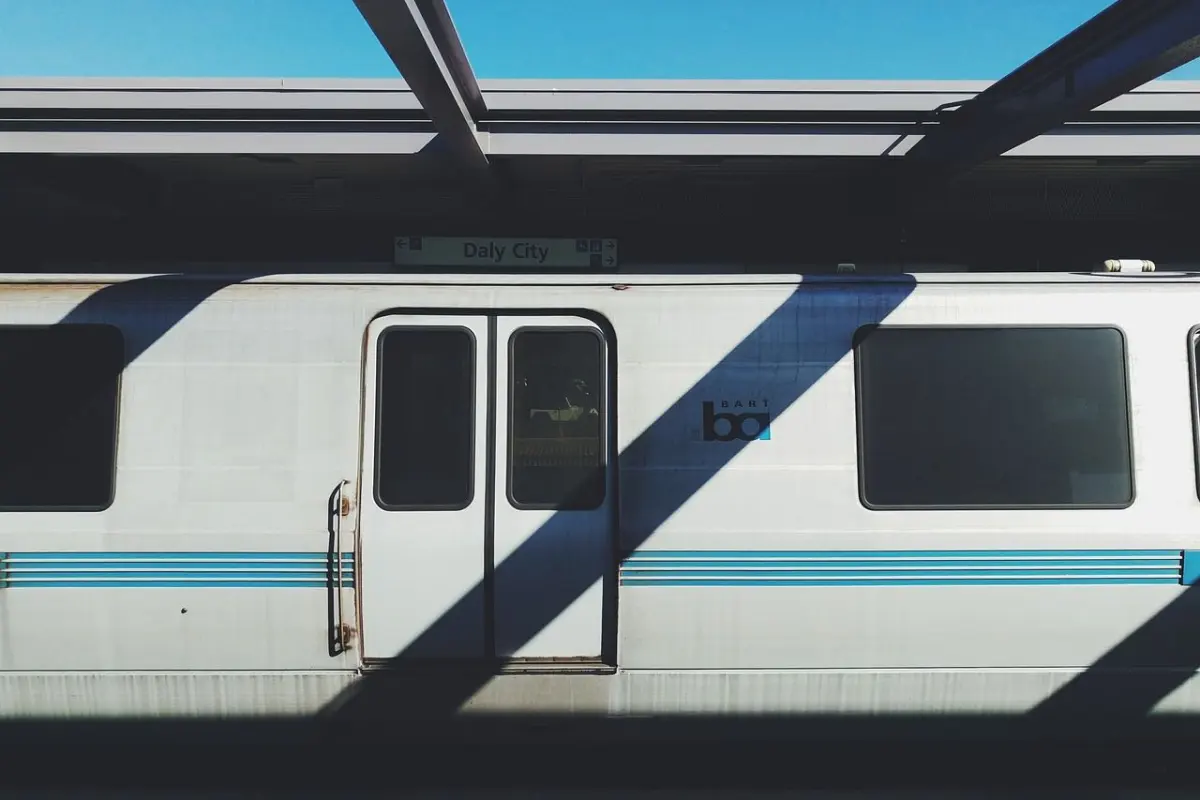
You may be asking how does BART work before you ride: fares depend on distance, and you tap in and out with a Clipper Card or a phone wallet. Pick your train by its color and its end-of-line station.
This guide is part of the site’s wider look at bay area culture and history, where getting around the region is part of everyday life.
| Item | Key fact |
|---|---|
| Fare basis | Based on distance |
| How to pay | Clipper Card or Apple/Google Pay |
| Tap rule | Tap in at your origin, tap out at your destination |
| Closest station to the UC Berkeley campus | Downtown Berkeley |
| Lines that reach that station | Red and Orange |
| UC Berkeley student fare, as of Fall 2025 | Free with BayPass |
These figures come from the UC Berkeley Parking and Transportation BART page. Fares, lines and programs can change, so check the source before you rely on them.
How do fares and payment work?
BART fares are based on distance, so a short trip is priced differently from a long ride across the Bay. The UC Berkeley page points riders to the BART Fare Calculator to estimate a trip before they go.
You can pay with a Clipper Card or with Apple Pay or Google Pay. Riders can add a new or existing Clipper Card to a mobile wallet and load funds using the phone’s payment options.
The rule to remember is to tap in at your origin and tap out at your destination. Because the fare depends on distance, the system needs both taps to know where your trip began and ended.
One program note: as of the Fall 2025 statement on UC Berkeley’s BART page, students there ride free with BayPass. That is a campus program, so check the source for who qualifies and whether it has changed.
Reading the lines and directions
BART routes are named by color, and the direction of a train is given by a station at the end of the line. When a route guide says “towards Richmond,” it means the train is heading to that end station, not that you must get off there.
The UC Berkeley page uses these line and direction pairings in its directions:
- Red line towards Richmond, and Red line towards Millbrae in the opposite direction.
- Orange line towards Richmond.
- Yellow line towards Antioch, and Yellow line towards SFO in the opposite direction.
- Green and Blue lines towards Daly City.
Some trips need a transfer, where you leave one train and board another line at the same station. The page names MacArthur, Bayfair and Coliseum as stations where riders change lines on routes to Downtown Berkeley.
Getting to Downtown Berkeley as an example
The closest station to the UC Berkeley campus is Downtown Berkeley, which the Red and Orange lines reach from across the Bay Area. It makes a useful worked example of how the system fits together.
| Where you start | Route to Downtown Berkeley |
|---|---|
| SFO or San Francisco | Red line towards Richmond; or Yellow line towards Antioch, then transfer at MacArthur to the Red or Orange line towards Richmond |
| OAK or Alameda County | Orange line towards Richmond; or Green or Blue line towards Daly City, then transfer to the Orange line at Bayfair or Coliseum |
| Antioch or Walnut Creek | Yellow line towards SFO, then transfer at MacArthur to the Red or Orange line towards Richmond |
| Richmond | Red line towards Millbrae |
These routes are summarized from the UC Berkeley Parking and Transportation BART page, and lines and transfers can change, so check the source before you travel.
Notice that the same city can appear as a destination on one train and a starting point on another. That is why checking the end-of-line name on the train matters as much as checking its color.
Etiquette on board
BART shares a few courtesy rules with most urban transit. The UC Berkeley page lists them for new riders:
- Offer your seat to seniors and people with disabilities.
- Keep your bags off the seats to make room for others.
- Do not eat or drink on the train, since it is not allowed.
- Use headphones for music or video, and keep the volume low.
- Let passengers exit the train before you board.
None of this needs a ticket or a card to follow, and it makes a crowded car easier for everyone.
Planning a trip and a day out
Before you leave, use the BART Trip Planner to see departure times and transfers. The UC Berkeley page also suggests the Transit App, which tracks campus shuttles, AC Transit and BART in real time.
A train ride is also a way into the region’s neighborhoods and local media. If you want background before you go, the mission district san francisco history guide gives context for one well-known San Francisco area.
For something to listen to on the way, the bay area community radio stations guide is a place to start for local audio. Remember to keep the volume low or use headphones, as the etiquette list above asks.
Frequently asked questions
Do I need a Clipper Card to ride BART?
Show answer
The UC Berkeley page says you can pay using a Clipper Card or Apple/Google Pay, so a phone wallet is an alternative to a physical card.
Do I have to tap out when I arrive?
Show answer
Yes. The guidance is to tap in at your origin and tap out at your destination, which is how a distance-based fare is worked out.
Which line goes from San Francisco to Downtown Berkeley?
Show answer
The UC Berkeley page says to take the Red line towards Richmond and get off at the Downtown Berkeley station.
Can I eat or drink on the train?
Show answer
No. The page lists eating and drinking as not allowed on BART trains.
Where can I check departure times?
Show answer
Use the BART Trip Planner for departure times and transfers, or the Transit App for real-time updates, as the UC Berkeley page suggests.